
One of the most distinctive artists of his generation, Sir Stephen Hough combines an international career as a pianist with those of composer, writer, and painter. The first classical performer to be awarded a MacArthur Fellowship (2001), Hough is a true renaissance man, exceedingly gifted as a pianist, educator, writer, painter, and composer.
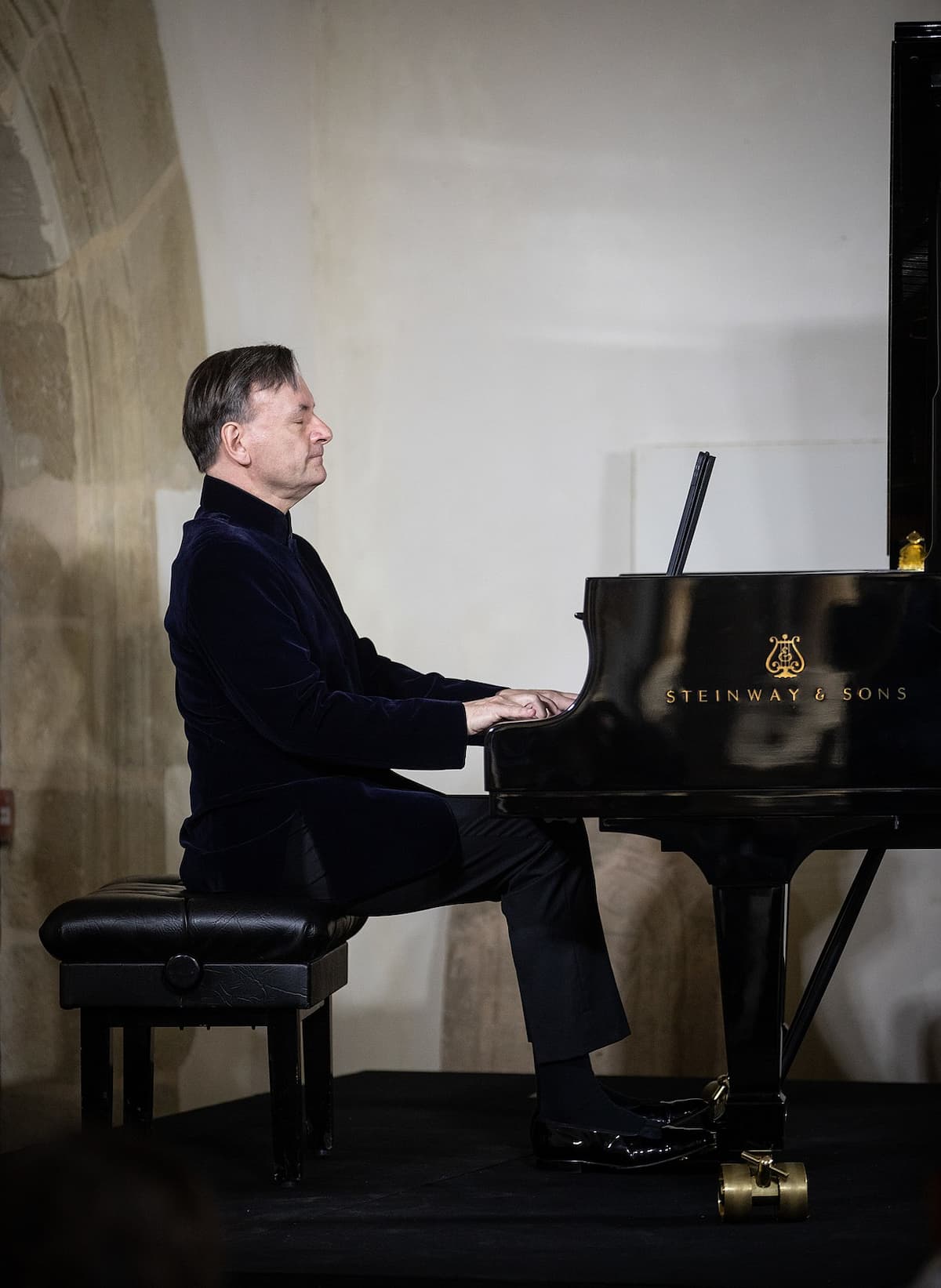
Sir Stephen Hough
While his achievements as a pianist are well-known and documented, Hough is also a respected author with four books and hundreds of articles to his name. In addition, a solo exhibition of his paintings was presented in London in 2012. It’s hardly surprising that The Economist included him in the list of “Twenty Living Polymaths.”
In addition, Hough is also a published and frequently commissioned composer, having crafted works for orchestra, choir, chamber ensemble, organ, harpsichord, and solo piano. He has received commissions from the Takács Quartet, the Cliburn, the Berlin Philharmonic Wind Quintet, and the Gilmore Foundation, among many others.
Stephen Hough: Sonata No. 4 (Vida Breve)
First Compositions
According to his father, Hough had memorised seventy nursery rhymes by the age of two. Be that as it may, singing was indeed his first form of musical expression, “especially as we had no classical music in my childhood home.” Hough sang hymns in primary school and church; later, he joined a choir in high school, and he joined the compulsory chorus at Julliard.
Hough started piano lessons at the age of six, and he began to compose at around the same time. He remembers writing a “Mass” in his teenage years, but Hough is generally dismissive of his juvenilia compositions. As he writes, “the Mass might still be at the bottom of a drawer somewhere—I fear to disturb the dust.”
Stephen Hough: Herbstlieder (Jacques Imbrailo, baritone; Stephen Hough, piano)
Transcriptions
Apparently, Hough composed a substantial number of works, but as he related in an interview, “mercifully, that pile of smudged sketches has disappeared.” These early efforts culminated in a viola sonata, the only early work that was actually published. However, for the next twenty odd years, Hough composed next to nothing, except an odd transcription or two. Hough related the story that after a recital in New York in the late 1990s, when he played his transcription of Rodger’s Carousel Waltz, he was chatting with the composer John Corigliano.
Rodgers and Hammerstein: Carousel Waltz, (arr. Hough)
Corigliano told Hough, “You should compose your own music. The only real difference between a transcription and writing your own pieces is using your themes rather than someone else’s.” This conversation became the starting point for a renewed engagement with compositions. Hough started to write little pieces for friends, and the bassoonist Graham Salvage from the Hallé Orchestra asked him to write a concerto. As Hough explained, “In a mad moment or reckless courage, I agreed to have a go and started sketching what eventually became The Loneliest Wilderness, my first serious piece in two decades.”
Stephen Hough: The Loneliest Wilderness (Steven Isserlis, cello; Tapiola Sinfonietta; Gábor Takács-Nagy, cond.)
First Commissions
The Loneliest Wilderness was inspired by the poem “My Company” by Herbert Read (1893–1968), containing the following lines:
But, God! I know that I’ll stand
Someday in the loneliest wilderness,
Someday my heart will cry
For the soul that has been, but that now
Is scatter’d with the winds,
Deceased and devoid.
I know that I’ll wander with a cry:
‘O beautiful men, O men I loved,
O whither are you gone, my company?’
The work is based on two main musical ideas: the interval of a descending fourth and a rising chain of thirds. Introvert and restrained, this musical oration has a strong Jewish flavour to it, taking its inspiration from “the heart-breaking regret of an army officer as he looks back at the loss of the company of soldiers under his command.”
Stephen Hough: String Quartet No. 1, “Les Six rencontres” (Takács Quartet)
Takács Quartet
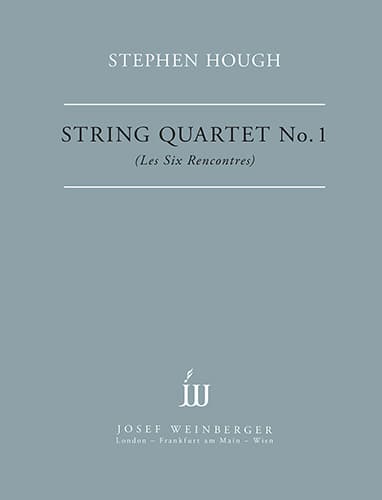
Stephen Hough’s String Quartet No. 1
Dedicated to the Takács Quartet, Hough’s first string quartet premiered in December 2021. As it was commissioned as a companion piece to works by Ravel and Dutilleux, the composer set out to explore “not so much what united their musical language, but what was absent from them.” Although there are no quotes or direct references to the composers of Les Six, as captioned in the subtitle, the composer imagines unspecified places and memory where meetings might have taken place.
This string quartet “evokes a flavour more than a style,” according to Hough, “but a flavour rarely found in the music of Ravel and Dutilleux. In Les Six it’s not so much a lack of seriousness, although seeing life through a burlesque lens is one recurring ingredient; rather it’s an aesthetic re-view of the world after the catastrophe of the Great War. Composers like Poulenc and Milhaud were able to discover poignance in the rough and tumble of daily human life in a way which escaped the fastidiousness of those other two composers.”
Stephen Hough: Piano Sonata, “Broken Branches” (Stephen Hough, piano)
Sonatas and Beyond
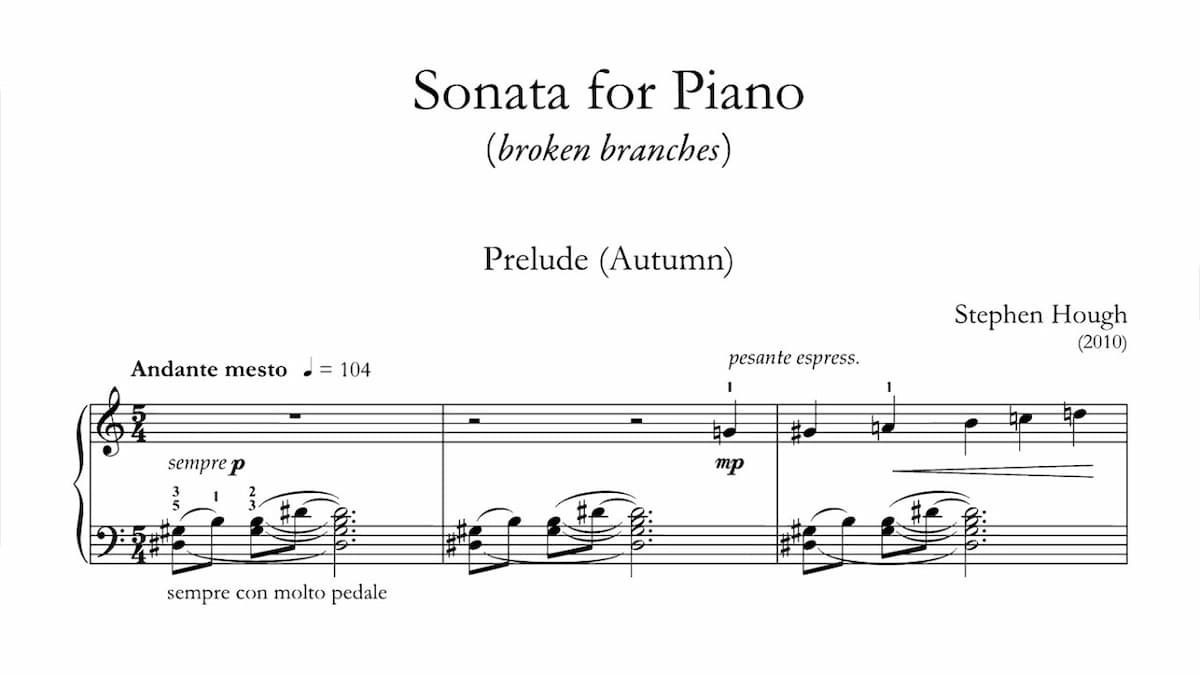
Stephen Hough’s Broken Branches
The term “Sonata” had a multiplicity of meanings over the years, but for Hough “it has kept its wordlessness and its seriousness; a sonata, regardless of form, is a statement of unity, if not uniformity.” And although the composer is wary of words or descriptions attached to